
Commercial Blinds in Brisbane: What Businesses Need to Know
Commercial blinds need to be durable, compliant, and functional. This guide covers everything Brisbane businesses need to know about choosing and installing blinds for offices, schools, retail spaces, and commercial buildings.
Related service: Commercial Blinds Supply and Install
Why Commercial Blinds Are Different
Commercial blinds face much harder use than residential blinds. Office windows might be opened and closed multiple times a day. Retail blinds need to withstand constant sunlight without fading. School blinds must be safe for children and resist tampering. This means commercial-grade components are required.
Compliance is another key difference. Commercial buildings must meet Australian standards for fire safety, accessibility, and workplace health and safety. Blinds need to be fire-retardant, especially in high-rise buildings or public spaces. Chain mechanisms must meet child safety regulations in schools and childcare centres.
Commercial blinds also need to perform specific jobs. In offices, they reduce glare on computer screens without making the room dark. In medical centres, they provide privacy for patients. In warehouses, they block heat and UV to protect stock. Choosing the right blind type for the job is important.
Best Blind Types for Commercial Spaces
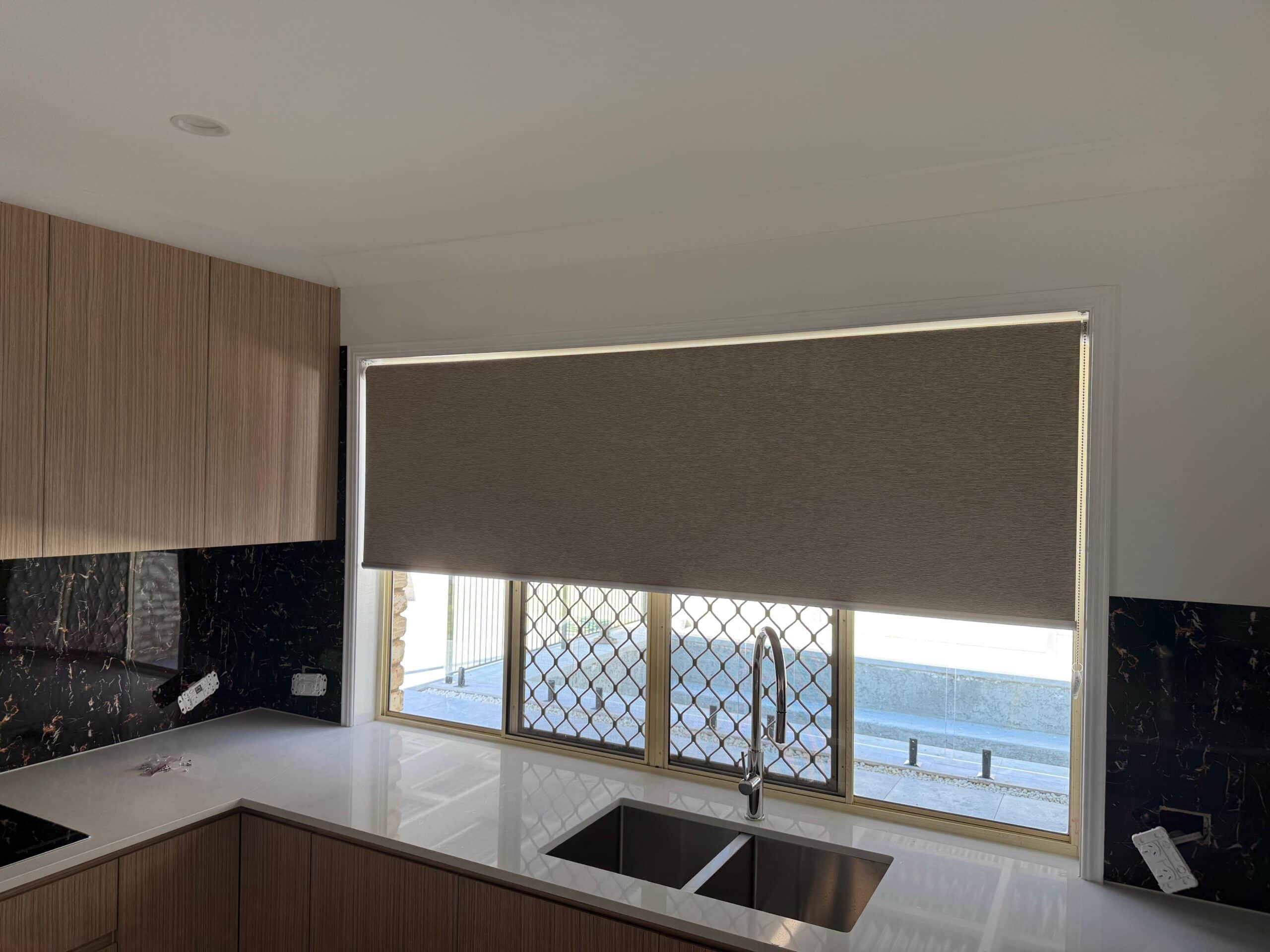
Roller blinds are the most popular choice for commercial projects. They are simple, reliable, and available in a huge range of fabrics. Sunscreen fabrics reduce glare while maintaining a view. Blockout fabrics suit boardrooms and presentation spaces. Roller blinds can be motorised for ease of use in large windows.
Vertical blinds are common in older office buildings. They suit sliding doors and large windows. The louvres can be tilted to control light or drawn open completely. Vertical blinds are affordable and easy to maintain, though they can look dated in modern fit-outs.
Venetian blinds offer precise light control. Aluminium venetians are durable and fire-resistant. Timber venetians suit executive offices and reception areas. The slats can be angled to direct light where you want it. Venetian blinds can be noisy in breezy conditions, so they suit internal windows better than external.
Panel glide blinds work well in meeting rooms and retail shopfronts. Wide fabric panels slide on a track. They create a clean, modern look and can be used as room dividers. Panel glides are also popular in medical centres for privacy screening.
Popular Commercial Applications
- Offices: Sunscreen roller blinds to reduce glare
- Schools: Blockout roller blinds with cordless operation
- Retail: Venetian blinds for window displays
- Medical centres: Privacy panel glides and blockout blinds
- Warehouses: Heavy-duty roller blinds with reflective backing
Fabric Selection for Performance and Compliance
Fabric choice affects both function and safety. Sunscreen fabrics have an openness factor rated as a percentage. A three percent openness blocks more light and heat than a ten percent openness. Lower openness reduces glare but also reduces your view. Offices usually choose five percent as a good balance.
Fire retardancy is required in most commercial buildings. Fabrics must meet Australian Standard AS/NZS 1530.3 for fire propagation. Suppliers will provide certification. PVC-coated polyester and fibreglass fabrics are naturally fire-resistant. Some decorative fabrics are treated with fire retardant chemicals.
Thermal performance matters in Brisbane. Metallised or reflective fabrics reduce solar heat gain. This lowers air conditioning costs, which is a big deal in large commercial buildings. Some fabrics are rated by their Solar Heat Gain Coefficient, with lower numbers meaning better heat blocking.
Durability is key. Commercial fabrics need to resist fading, mould, and tearing. Look for fabrics with high UV stability ratings. PVC fabrics are easy to wipe clean, which suits medical and food service environments. Anti-static fabrics reduce dust attraction in offices.
Motorisation and Smart Controls
Motorised blinds make sense in commercial buildings. Large windows and high installations are awkward to operate manually. Motorisation improves accessibility for staff and visitors. It also looks professional with no chains dangling.
Basic motorisation uses a remote control or wall switch. Each blind or group of blinds can be controlled independently. This suits small offices and retail stores. More advanced systems integrate with Building Management Systems. Blinds can be programmed to open and close at set times or based on sunlight sensors.
Smart blinds can be controlled via smartphone apps. This is useful for facility managers who want to adjust blinds across multiple rooms from one device. Some systems work with voice assistants like Alexa or Google Home, though this is more common in residential settings.
Solar-powered motors are available. These suit buildings where running power cables is difficult or expensive. A small solar panel charges a battery that powers the motor. Solar motors work well in Brisbane’s sunny climate.
Brisbane Climate and Commercial Blinds
Brisbane’s heat and humidity place demands on commercial blinds. West-facing offices can become unbearably hot in summer. The right blinds reduce heat gain and lower energy costs. This is good for your budget and your sustainability targets.
Glare is a major issue. Computer screens are hard to read when sunlight reflects off the glass. Staff squint and develop headaches. Sunscreen blinds cut glare without making the office dark. Positioning monitors away from windows also helps, but blinds are the main solution.
Humidity can cause mould on some fabrics, especially in air-conditioned buildings where condensation forms. PVC and polyester fabrics resist mould better than natural fibres. Good ventilation is also important.
Storms and high winds can damage external blinds. Make sure brackets are fixed securely into masonry or steel. Motorised blinds can be programmed to retract automatically when wind speeds exceed a set level.
Common Questions
How long do commercial blinds last?
Commercial-grade blinds typically last seven to ten years with regular use. High-quality mechanisms are tested for tens of thousands of cycles. Fabric life depends on sun exposure and cleaning. Metallised fabrics may start to delaminate after five to seven years in harsh sun. Regular maintenance extends lifespan.
Can commercial blinds be installed outside business hours?
Yes. Most installers offer after-hours or weekend installation to avoid disrupting your operations. This is common for office fit-outs and retail stores. Let your supplier know your preferred timeframe when booking. There may be a small after-hours fee.
Do I need different blinds for air-conditioned buildings?
Not necessarily, but thermal blinds help reduce cooling loads. Buildings with large glass areas lose a lot of conditioned air through the windows. Reflective or low-emissivity blinds reduce this loss. Some commercial buildings require blinds as part of their energy efficiency rating. Check with your building manager or engineer.
Bulk Orders and Project Management
Commercial projects often involve dozens or hundreds of windows. Managing orders, delivery, and installation requires careful coordination. Experienced suppliers provide project management support. They work with builders, architects, and project managers to meet deadlines.
Bulk pricing is available for large orders. The more units you order, the better the per-unit price. Suppliers can usually colour-match fabrics to your corporate branding or interior design. Custom colours may have longer lead times.
Staged delivery is common. If your building is being fitted out in stages, blinds can be delivered and installed in batches. This avoids having stock sitting on site where it could be damaged. Clear communication with your supplier ensures smooth delivery.
Warranties on commercial blinds are usually longer than residential. Five to seven years is typical for mechanisms and fabric. Make sure you understand what the warranty covers. Some warranties are void if blinds are not maintained or are installed incorrectly.
When to Call a Professional
Commercial blind installation requires expertise. Installers must hold the right safety certifications to work on commercial sites. They need insurance and often a white card for construction sites. Brackets must be fixed into concrete, steel, or load-bearing walls, which requires proper tools and knowledge.
Atlas Blind & Curtain offers professional Commercial Blinds Supply and Install across Brisbane, Ipswich, and Logan. Our team works with businesses, project managers, and architects to deliver compliant, durable blinds on time and on budget. We handle measuring, supply, installation, and handover.
Need Help in Brisbane, Ipswich or Logan?
Contact Atlas Blind & Curtain for expert blinds and curtains services across Brisbane, Ipswich and Logan.
Phone: 07 3195 2934
Address: 4/30 Kelliher Rd, Darra QLD 4076